When I first landed in Uzbekistan back in 2018, I didn’t expect to stay this long. Yet here I am, eight years later, still convinced it’s one of the few places where the math of life makes sense. You get strong value for money, a real sense of community, and a lifestyle that allows you to focus on building. It’s not perfect — but if you want lower burn without shrinking your life, Uzbekistan deserves your attention.
(If you’ve been following this series, you’ve already seen my articles on [setting up a business], [getting your visa], and [how IT Park supports entrepreneurs]. This one is about the daily realities once you’re here.)
Rent is often the biggest factor shaping a monthly budget. In central Tashkent, a furnished two-bedroom apartment in a modern building typically costs $400-700 per month, depending on district, building quality, and whether utilities are included. Outside the center, prices drop: one-bedroom units in older Soviet-style buildings can be found for $250-400. Beyond Tashkent, historic cities like Samarkand and Bukhara often offer one- to two-bedroom apartments in the $220-450 range. These cities also host regional hubs of IT Park, which I’ve written about previously, making it possible for entrepreneurs to access resources, co-working, and talent pools while benefiting from lower housing costs. Buying is also an option for long-term residents, with prices per square meter ranging from $600-1,400 in central Tashkent, compared to $400-650 in regional cities. Crucially, Uzbekistan offers a simplified Residence Permit (ВНЖ) track for foreign investors purchasing residential real estate. According to current regulations (Presidential Decree No. UP-5611, amended by UP-113), foreigners can obtain a residence permit by purchasing property valued at a minimum of $300,000 in the Tashkent region, $200,000 in major regional hubs like Samarkand, Bukhara, and Namangan, and $100,000 in other regions.
One of Uzbekistan’s underrated perks is its fresh produce. Tomatoes, melons, cherries, and herbs taste like food should taste, and seasonal fruits are abundant in every local market. If you cook at home, expect your monthly grocery basket to run $120-200, depending on how many imported goods you add. For example, a dozen eggs averages 16,200 UZS ($1.35) a loaf of bread is around 5,000 UZS ($0.40), and a kilo of chicken breast costs about 45,000-55,000 UZS ($3.75-4.5). Eating out remains affordable: a hearty meal at a local café is typically $3-6, while dinner for one at a mid-range restaurant will cost $10-20. With those numbers, dining out can easily become part of a weekly routine rather than an occasional splurge.
Private healthcare in Uzbekistan is accessible and reasonably priced by international standards. A basic consultation at a private clinic in Tashkent typically costs $10–35, while routine dental care is similarly affordable. When I delivered my son in a local maternity ward, the total cost was $400, which included a three‑day stay, meals, medicine, and doctor fees — an experience that showed how professional yet affordable local services can be. Many expats use a hybrid model: day‑to‑day care handled locally, with more complex procedures managed abroad in regional hubs like Turkey or South Korea. If you opt for international insurance, it’s important to confirm coverage includes private hospitals in Tashkent as this is still not widely available.
When I first moved to Uzbekistan in 2018, there were no ride-hailing apps available. If you wanted to get across town, you had to flag down any passing car, agree on a price, and often negotiate in basic Uzbek or Russian. It was a crash course in both languages. Fast forward to 2025, and mobility in Tashkent has become much easier.
The Tashkent Metro (one of the world’s most stunning metro systems) remains clean, efficient, and extremely affordable at just 1,700 UZS (about $0.14) per ride. On the roads, ride-hailing apps like Yandex Go, Uklon and MyTaxi have transformed taxi access, with average fares across the city typically ranging from 15,000-35,000 UZS ($1.25-$2.9) depending on distance and time of day.
For those driving, GlobalPetrolPrices reports that gasoline in Uzbekistan averaged around 11,200-12,500 UZS per liter ($0.93-$1) in mid-2025, with weekly fluctuations reflecting global oil trends. Utilities for a standard 85-100m² apartment usually cost $40-80 per month, covering electricity, water, heating, and waste removal. Home internet has become faster and more stable compared to a few years ago, with Uztelecom and private providers offering packages in the $10-20 per month range for unlimited data. Together, these improvements make daily life in Uzbekistan far more convenient than it was just a few years ago.
Forget Facebook — Telegram is Uzbekistan’s true digital town square. People use it for everything: news, city service updates, classifieds, grocery orders, and restaurant menus. Most neighborhoods and buildings have their own Telegram groups where you can find a plumber or sell furniture in minutes. For expats, Telegram is also the backbone of social and professional life, from job leads to weekend events.
Since 2017, Uzbekistan has been on a purposeful path of reform — and recent data makes the progress clear. From January to September 2025, the economy grew 7.6%, reaching a GDP of $108.7 billion. Uzbekistan is expected to sustain this solid economic momentum, with GDP growth projected at about 6.2% in 2025 and 6% in 2026.
For founders, this steady GDP growth and broad economic momentum matter. Stability and reforms create an environment where businesses can launch, iterate, and scale. With IT Park’s regional hubs (as I discussed in my business setup guide), entrepreneurs benefit from both national growth and localized support networks.
Uzbekistan’s culture is one of its strongest attractions, blending ancient heritage with a lively modern arts scene. Cities like Samarkand, Bukhara, and Khiva are UNESCO World Heritage sites, drawing travelers with their turquoise domes, grand madrasahs, and Silk Road history. But beyond tourism, there’s a vibrant cultural calendar that locals and expats enjoy year-round. In Tashkent, affordable tickets to philharmonic concerts, ballet performances, and theater shows often cost as little as 30,000-70,000 UZS ($2-$6), making world-class performances accessible to everyone. Regular cultural festivals, contemporary art exhibitions, and open-air concerts in parks bring people together and keep the city’s social life dynamic without breaking the bank. For expats, this mix of deep history and accessible culture adds another layer of richness to everyday living.
It’s not all smooth sailing. Imported brands and niche equipment can be expensive due to duties and logistics. Expect lead times rather than last-minute imports. Payments are modernizing quickly, but cash is still common in markets. And while English is spreading, learning a few Uzbek phrases goes a long way:
Assalomu alaykum = Hello
Yaxshimisiz = How are you?
Rahmat = Thank you
Nech pul? = How much does it cost?
Here’s a snapshot of what a comfortable lifestyle costs for expats in Tashkent (excluding school fees):
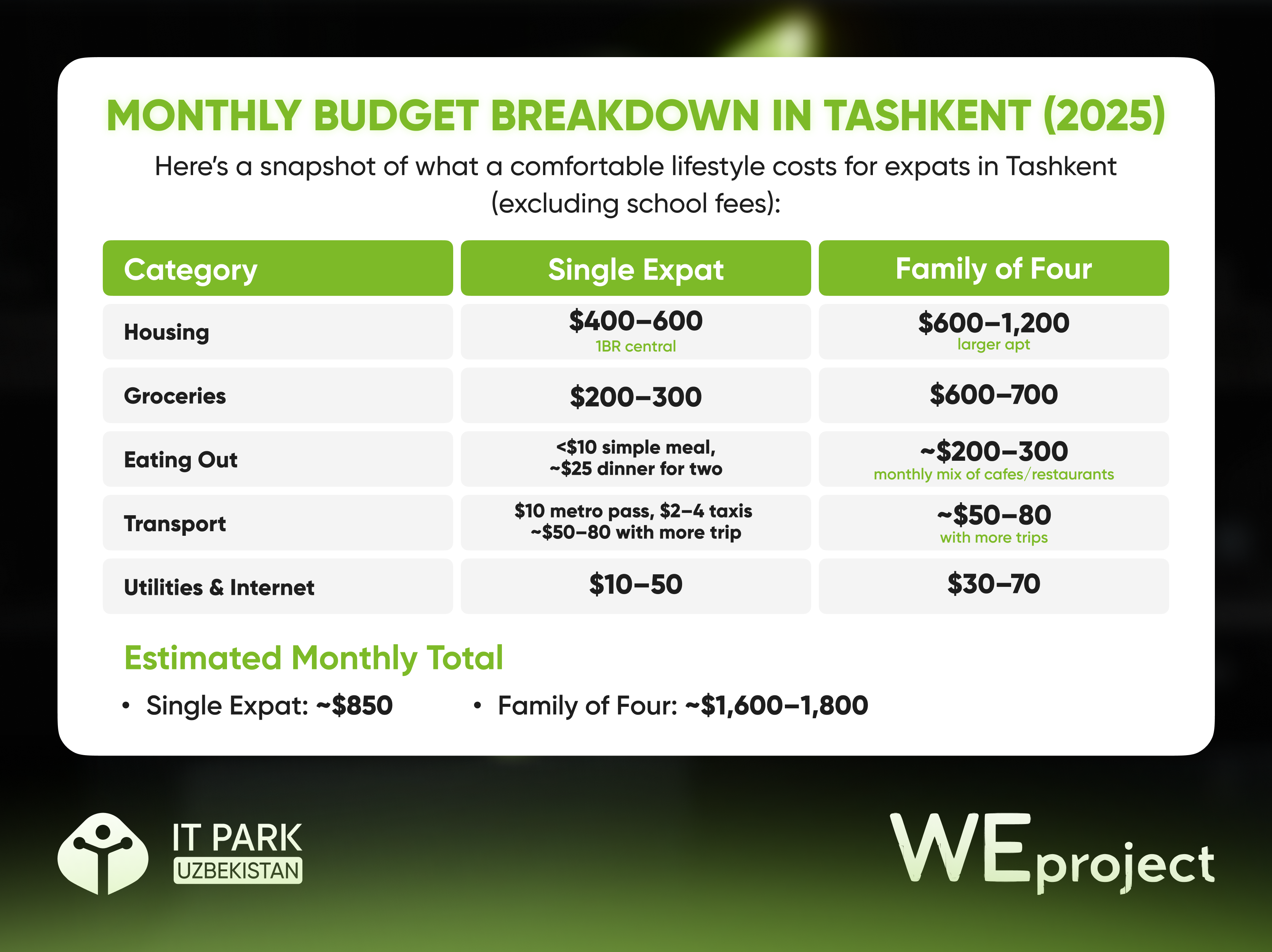
Estimated Monthly Total
Three reasons keep founders here:
With reforms moving forward, the macro outlook constructive, and daily life refreshingly sane, Uzbekistan remains one of the most compelling basecamps for founders in 2025.
Ready to make your move? Pack your suitcase, download Telegram, and see how far your budget and your business can stretch in Uzbekistan.
19 September 2026
19 September 2026
18 September 2026
18 September 2026