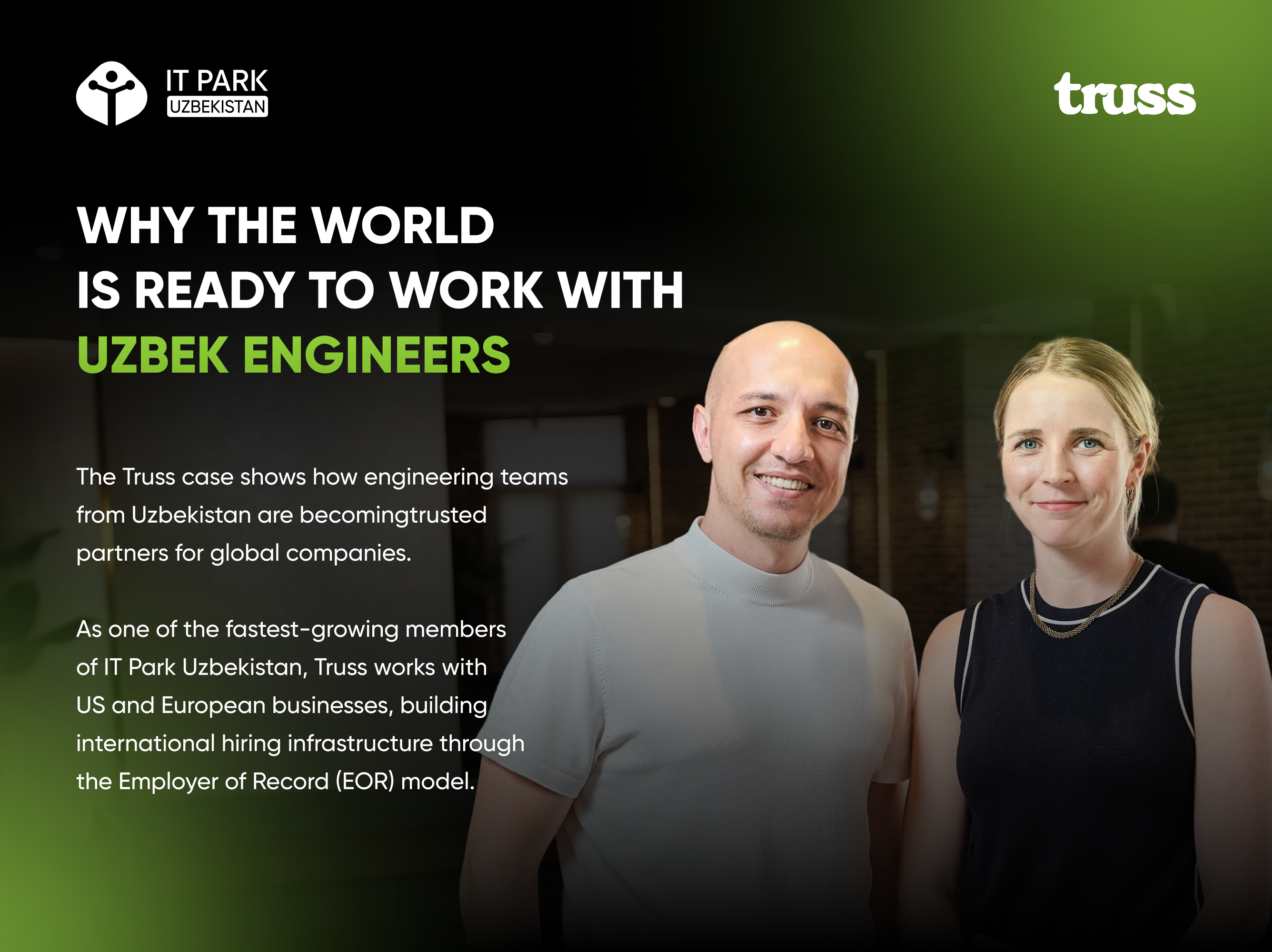
The success of Truss reflects long-term confidence in local talent, systematic support from IT Park, and a commitment to creating new career opportunities for specialists across Central Asia. The company not only expands the export of IT services but also enables foreign employers enter the Uzbek market with zero risk, establishing a new level of trust in the region on the international stage.

The story of Truss predates the company itself. In the early 2000s, Eric Hoopmann, future CEO of Lincoln Labs, began exploring global talent markets. He became one of the first representatives of the U.S. tech sector to recognize Uzbekistan as a promising source of engineering talent.
During this period, Eric met Farrukh Umarov, a highly skilled engineer from Uzbekistan. Their collaboration soon led Farrukh to become a key technical leader in Eric’s company — DealerFire, a software firm based in Oshkosh, Wisconsin. DealerFire grew rapidly, supported by a small but exceptionally capable Uzbek engineering team of around 10–15 specialists. Together they built award-winning software, scaled the business, and ultimately achieved a successful acquisition by DealerSocket.
This experience convinced the founders of the strong potential of Uzbek engineers — their professionalism, dedication, and ability to create world-class products. After the company was sold in 2020, Eric and Farrukh founded Lincoln Labs and decided to expand the proven model, giving a new generation of specialists the opportunity to work with international companies.
“This is how Truss emerged — a company created to connect developers from Uzbekistan, and later from other regional markets, with U.S. startups and technology corporations. Julia and I, who were also part of the the DealerFire story, joined this mission. Together, we built a platform that opens global opportunities for engineers and strengthens the region’s export potential,” said Kadir Fuzaylov.
Uzbekistan became a logical choice for Truss because years of working with local specialists demonstrated their strong technical foundation, motivation, loyalty, and readiness for long-term collaboration. A growing technology ecosystem and strong work ethic further reinforced the founders’ belief that Uzbek engineers can compete on equal terms with talent from established global outsourcing hubs.
For Jizzakh specifically, favorable conditions for building a technology company played a major role. Registration in the region enabled Truss to benefit from IT Park membership, simplify administrative procedures, and contribute to the development of the local IT community. Starting operations in the Jizzakh allowed Truss to operate at lower costs, scale rapidly, and become part of a region that actively seeks to expand its presence in the global technology market.
“We learned about the Zero Risk program in the summer of 2024 during our visit to Uzbekistan and meeting with the IT Park team. At that time, Truss was actively scaling, and the support offered through the program became a timely mechanism that reduced operational workload and allowed us to focus on growth, hiring, and service improvement. Re-registering in the Jizzakh region was a natural step and marked the beginning of a sustainable partnership with IT Park,” explained Kadir Fuzaylov.
Two components of the Zero Risk program were especially valuable for Truss:
1. Reimbursement of hiring expenses up to $500. This helps the company cover part of the operational costs associated with onboarding new specialists. For a growing startup, even modest financial support creates meaningful opportunities for expansion and reinvestment.
2. Reimbursement of up to 15% of the payroll for Uzbek employees. This benefit significantly reduces monthly expenses, enabling the company to hire more people, improve service quality, and scale more rapidly.
For Truss, Zero Risk became not simply a form of financial support but a mechanism that accelerated the company’s growth and strengthened international partners’ confidence in the region. Combined with strong engineering talent and IT Park’s support, it created predictable growth conditions and allowed the company to focus on what matters most — building a sustainable model for global hiring.
“Our main achievement in Uzbekistan is the scale of talent attraction. We now employ more than 150 specialists, and our client base has grown to around 20 active international companies, including Infinity, Sunrun, Businessolver, and FreightPop. We have also created a robust talent pool — more than 10,000 candidates are registered on our platform today. This reflects both market’s trust and the strong interest among local specialists in working with international employers,” noted Kadir Fuzaylov.
Since joining the Zero Risk program, Truss’s client base has increased by roughly 40%. The stability and support provided by the program enabled the company to scale more confidently and facilitated cooperation with new foreign companies. Today, Truss is one of the leading partners for U.S. companies hiring talent in Uzbekistan. Recently, the company has received more hiring requests from European companies as well.
Truss plays an important role in expanding Uzbekistan’s export potential in IT and HR services. By connecting local specialists with U.S. and European companies, Truss creates international employment opportunities at a scale that did not exist previously.
“Our model also allows foreign companies to hire specialists in Uzbekistan with zero risk, which encourages their entry into the market and contributes to job creation in the country,” said Kadir Fuzaylov.
Interest from Uzbek specialists in international companies is rising rapidly. Many seek to work with U.S. and European employers for the sake of global experience, competitive incomes, and enhanced career growth. At the same time, global interest in Uzbek talent is also increasing. The last two years have demonstrated one clear fact: the region has strong engineers, and the world is ready to work with them.
“By registering in the Jizzakh region, we are increasing the region’s visibility, attracting investment, and creating new jobs. Foreign companies that work with us learn about Jizzakh through our presence, and many begin exploring the region more deeply. A chain effect emerges: more companies show interest, more specialists find employment, and the region’s IT sector develops faster.
As a member company, we see IT Park becoming increasingly active, supportive, and attractive for foreign partners. IT Park continues to improve the business environment, streamline processes, promote Uzbekistan internationally, and launch programs like Zero Risk that lower entry barriers for foreign companies. All of this makes the country significantly more competitive in the global outsourcing and remote hiring market,” explained Kadir Fuzaylov.
Initially, Truss employed a classical outsourcing model, but it soon became clear that this approach was difficult to scale: U.S. companies increasingly preferred not to outsource entire projects but to directly hire strong developers and integrate them into their teams. This shift led the company to adopt the Employer of Record (EOR) model, which enables clients to hire specialists without establishing a legal entity, taking on HR and tax responsibilities, or navigating local regulatory environments. Truss fully manages legal, HR, and compliance functions, creating a transparent, secure, and convenient format for international hiring.
Demand for EOR services is rising globally as companies seek to hire talent worldwide without opening foreign offices or managing regulatory complexities. In Uzbekistan, demand is especially high due to the large and diverse talent pool. The most in-demand profiles among Truss’s U.S. clients include:
Truss also sees rapid growth in interest toward Uzbekistan, Georgia, and Kazakhstan and is preparing for the next wave of demand — particularly in the field of artificial intelligence. Building strong engineering teams and expanding AI competencies are key elements of the company’s long-term strategy.
“Today, Truss operates in Uzbekistan, Georgia, and Kazakhstan. We chose these markets because they consistently produce strong, highly motivated developers who are ready to work with international companies and live in countries that U.S. companies do not always consider first when expanding. These markets are less saturated, which offers an advantage compared to regions where major players such as Microsoft, Meta, and Google operate and can outbid salaries,” explained Kadir Fuzaylov.
These countries have dynamic IT ecosystems supported by modern educational programs and strong English proficiency, making their specialists competitive globally. Among them, Uzbekistan stands out as the strongest success story: the local IT sector is growing rapidly, and IT Park’s support provides favorable conditions for technology companies.
As confidence grows, many clients eventually open their own offices in Uzbekistan, directly strengthening the local IT industry. As a result, the region attracts a growing number of international companies, and Truss, together with IT Park, plays a key role in helping the region expand its global presence.
The future of hiring is shaped by several global trends that directly influence Truss’s strategy:
1. AI-driven recruitment and automation. Companies require faster, more precise hiring solutions, and AI is becoming a central tool for screening, matching, and reducing time-to-hire.
2. Shift toward emerging markets. As traditional markets become increasingly saturated and costly, companies are turning toward Central Asia, where specialists combine loyalty, strong technical expertise, and competitive salaries.
3. Remote work. The world is moving to long-term remote collaboration. Companies are less constrained by borders, making the EOR model even more in demand.
4. Early-stage talent channels. Businesses need access to young, fast-growing specialists — a trend that aligns with Truss’s university and academy partnerships in Uzbekistan, Georgia, and Kazakhstan.
Truss is preparing for these shifts, focusing extensively on AI and regional expansion.
“In the next two years, our primary goal is to become the leading recruiting and Employer of Record provider in Central Asia. We want every international company looking at the region to immediately recognize Truss as the key partner capable of quickly and reliably helping them hire specialists of any profile.
To achieve this, we are building the largest developer database in the region and strengthening partnerships with universities, academies, and training centers. This will enable us to hire both top senior specialists and the most promising graduates.
Another key priority is the implementation of artificial intelligence. We plan to integrate AI into our platform to significantly reduce time-to-hire. Our goal is simple: to enable companies to hire employees in days instead of weeks,” emphasized Kadir Fuzaylov.
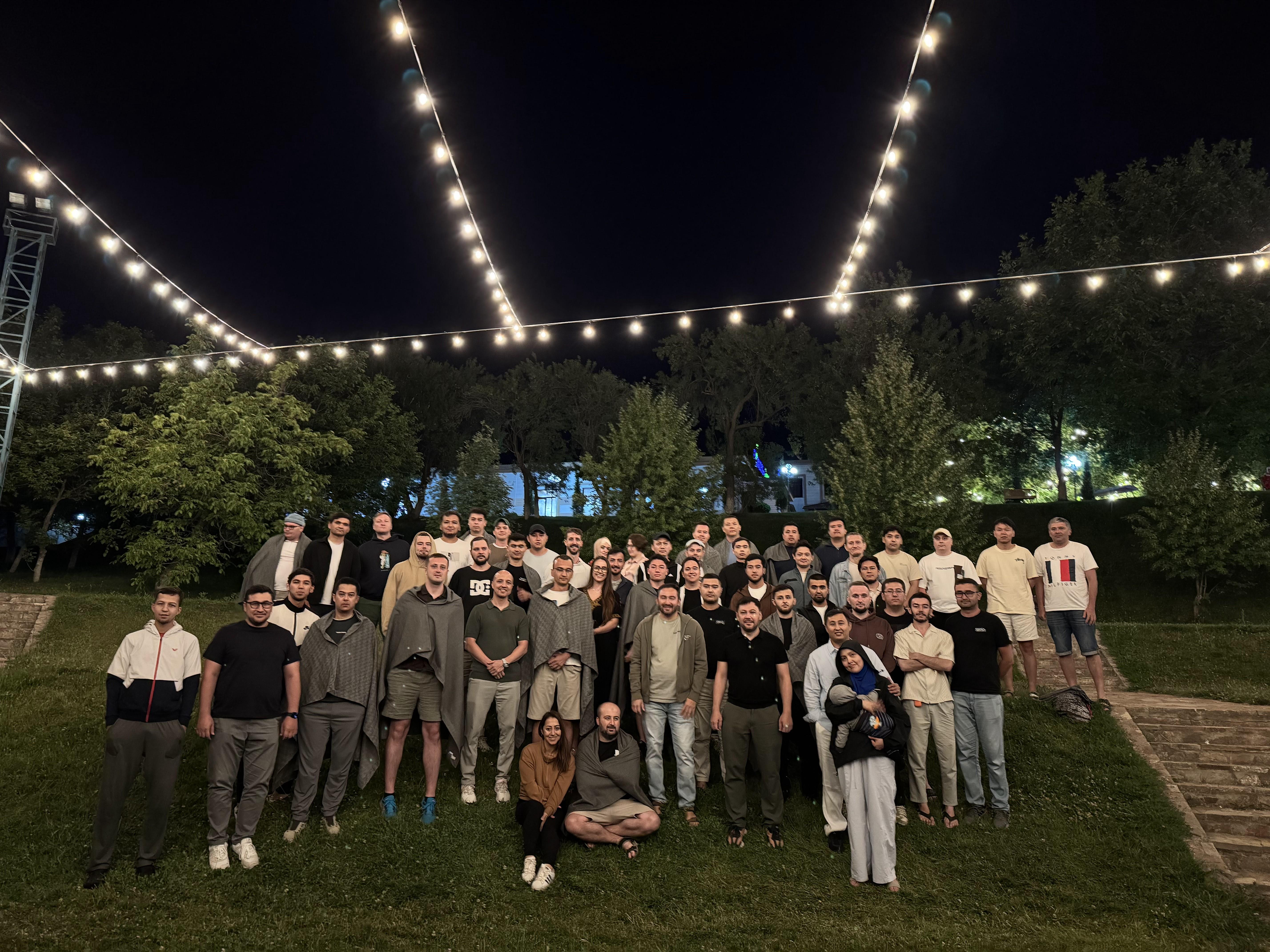
This combination of regional leadership and technological innovation forms the foundation of Truss’s development strategy for the coming two years.
Uzbekistan has the potential to become one of the world’s leading markets for IT outsourcing and remote hiring. It is an emerging market with a number of strategic advantages:
1. A rapidly expanding pool of qualified IT specialists
2. Growing availability of academies and training programs
3. Highly motivated youth aiming to work in international companies
4. Active government support for the technology sector
5. A talent pool that values loyalty and long-term engagement
For these reasons, Uzbekistan offers something rarely found in the global technology landscape: highly skilled, motivated specialists with reasonable salary expectations.
“At Truss, we see this every day. Companies from the United States, and increasingly from Europe, show growing interest in hiring our specialists. With strong university partnerships and a large candidate base, we are confident that over the next decade Uzbekistan can become a major hub for global remote hiring,” explained Kadir Fuzaylov.
The case of Truss clearly illustrates the role IT Park Uzbekistan plays in building a sustainable ecosystem for international technology business. Through support programs such as Zero Risk, the development of regional IT clusters, and systematic work with foreign companies, IT Park has established predictable and competitive conditions for entering the Uzbek market. This not only strengthens the country’s export potential but also builds trust among global partners, positioning Uzbekistan as a key growth location on the world map of technology and talent.