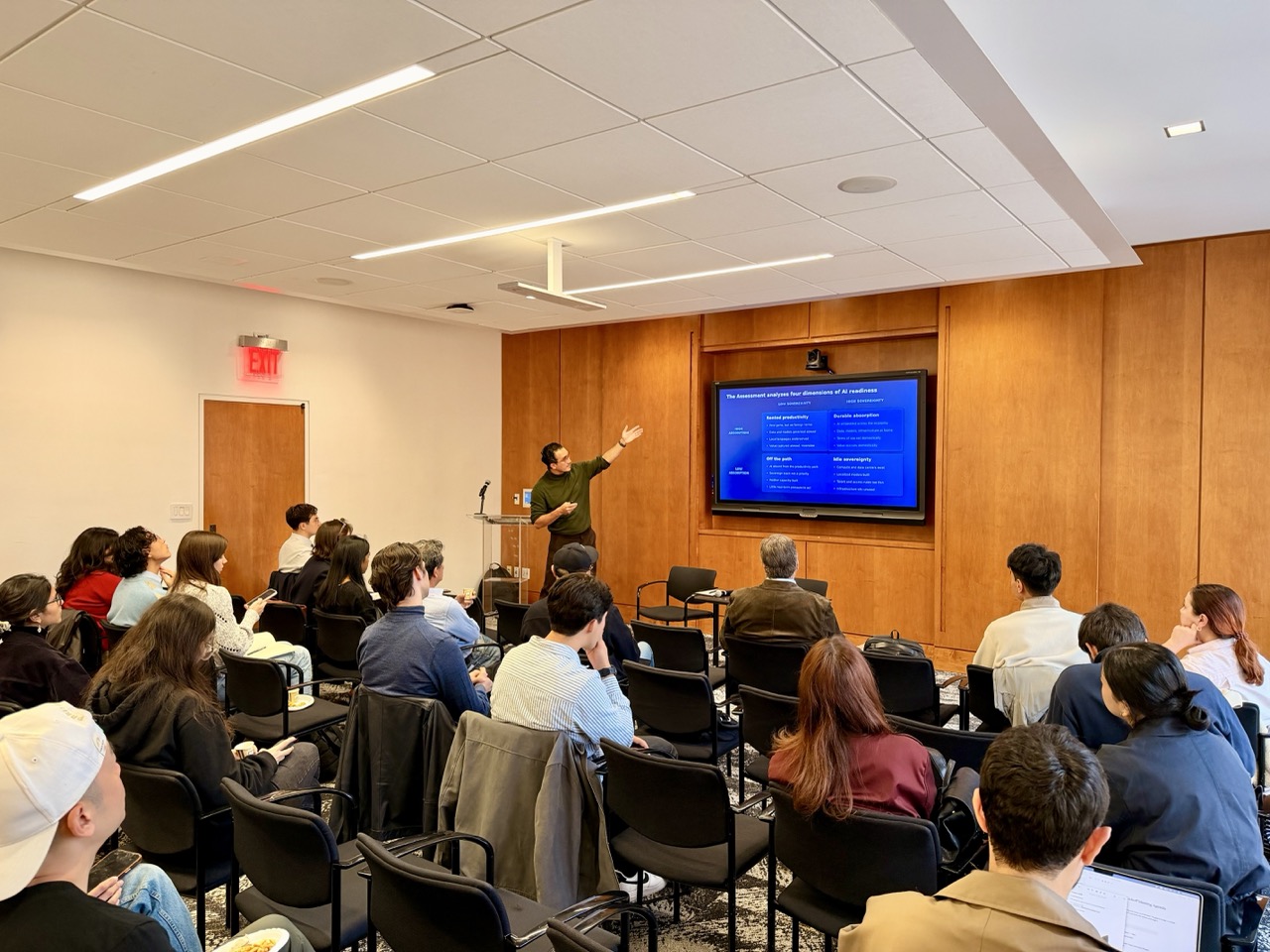
Shamil Ibragimov, Director of Research at the MIT Kuo Sharper Center, presented the study, which covers Uzbekistan, Kazakhstan, Kyrgyzstan, Tajikistan, and Azerbaijan. It represents the first comprehensive assessment of the region’s AI readiness using a unified methodology. Research began in April 2026, and the preliminary findings were presented on September 22 at ICT Week Uzbekistan 2026 in Tashkent.
Central Asia and the Caucasus have made substantial progress in AI development over the past three years. However, the region’s ambitions continue to outpace its infrastructure. Computing capacity and reliable energy supply were identified as the main constraints.
Government Policy. All five countries have established regulatory frameworks for AI, with oversight assigned at least at the ministerial level. According to the speaker, this demonstrates strong government commitment to technological development. In Uzbekistan, AI-related provisions have been incorporated into existing legislation.
Infrastructure. The region continues to rely on international cloud platforms with data centers located in Frankfurt, Delhi, and Dubai. Three years ago, the region had no GPU-based computing capacity. Today, it operates three supercomputers ranked among the world’s TOP500 systems. According to Ibragimov, decisions made over the next one to two years regarding access to advanced chips and energy resources will shape the region’s development over the coming decade.
Talent and Research. Between 2021 and 2025, countries in the region produced 4,278 AI-related scientific publications, with annual research output increasing more than fivefold. Research quality has also improved: 42% of papers were published in first-quartile (Q1) journals, while the region’s field-weighted citation impact reached 1.5, compared with the global average of 1.0. Large-scale AI education in the region is primarily delivered through short online courses. The next priority is to develop more advanced training programs that enable specialists not only to use AI tools but also to build new AI models.
Private Sector. The study examined 650 startups and 103 companies employing more than 100 people.
- 80% of surveyed startups identify themselves as AI companies. Among startups founded in 2023 or later, the figure reaches 81%.
- 84% of startups report GPU shortages, while 71% rely on foreign cloud platforms.
- 68% of large companies are still exploring AI applications or implementing pilot projects. Only 3% have made AI central to their business operations, while nearly half lack a clearly defined AI strategy.
Shamil Ibragimov identified the gap between startup capabilities and corporate demand as one of the region’s major opportunities. He also emphasized the importance of regional integration. While the five countries represent relatively small markets individually, a unified regional market could attract significantly greater investment. He highlighted the region’s renewable energy potential, central location in Eurasia, and relative stability as additional competitive advantages.
- Regional Leader in AI Research Publications. Uzbekistan’s AI-related scientific publications increased from 26 in 2021 to 861 in 2025, representing growth of more than 27 times. Uzbekistan surpassed Kazakhstan, which recorded 579 publications. Together, the two countries account for 82% of the region’s peer-reviewed Scopus-indexed research papers.
- National Supercomputer. The Digital Government National Supercomputer in Tashkent has been operating under the Ministry of Digital Technologies since July 2026 and is included in the global TOP500 ranking. Its utilization reached approximately 90% during its first month of operation, with plans to triple computing capacity by 2027.
- Large-Scale Education. Of the region’s 4.7 million Coursera learners, 3.4 million are based in Uzbekistan. The study identifies the One Million Uzbek Coders program as one of the key initiatives supporting AI skills development.
- Startups. 79% of surveyed Uzbek startups identify themselves as AI companies.
- Energy Infrastructure. Electricity transmission and distribution losses in Uzbekistan stand at 5%, the lowest rate in the region. The country has also announced the DataVolt and LinkWise data center projects.
The speaker identified IT Park Uzbekistan, alongside Astana Hub and Kyrgyzstan’s High Technology Park, as one of the region’s key mechanisms for attracting technology companies. Members of such technology parks benefit from substantial tax incentives, while Uzbekistan is developing Enterprise Uzbekistan, a special legal zone for investors and technology companies, within the IT Park ecosystem.
The study’s findings also reflect the growth of Uzbekistan’s digital economy. According to the results of the first half of 2026:
- 607 new export-oriented members joined the ecosystem, representing a 177% year-on-year increase;
- 297 new members with foreign capital joined (+154%), bringing the total number of such companies in the ecosystem to more than 1,200;
- The ecosystem includes companies from 75 countries, with the United States accounting for the largest number of new foreign members;
- 1,200 members export services and digital products to 102 countries, compared with just eight export destinations in 2017. Of these companies, 315 operate in Uzbekistan’s regions;
- North America remains the largest export market, accounting for 54% of total exports.
The presentation of the study in New York marks another step in IT Park Uzbekistan’s efforts to promote the country’s technological potential among American investors and partners.
MIT Kuo Sharper Center for Prosperity and Entrepreneurship is a center at the Massachusetts Institute of Technology that has been promoting innovation-driven entrepreneurship as a pathway to prosperity in emerging markets since 2007. Over this period, the center has supported more than 600 innovators, including over 400 fellows from 67 countries. Companies founded by its fellows serve more than 17 million customers.
IT Park Uzbekistan is a technology park operating under the Ministry of Digital Technologies of the Republic of Uzbekistan. It serves as a key platform for developing technology companies, startups, and exports of digital services and products.
02 November 2026
29 October 2026
28 October 2026
27 October 2026